5 Vital Conversations for Nonprofit Leaders

What does regular communication with your team actually look like? Many nonprofit leaders check in consistently, but those conversations often focus on numbers, campaigns, and events. That information matters, but it rarely helps teams work better together or move results forward. The harder, more valuable conversations get bumped to another day that never quite arrives.
That is a missed opportunity that nonprofits cannot afford. Research from the Council of Nonprofits has documented widespread staffing shortages, and Mission Edge reports that workforce sustainability has shifted from a looming concern to an active crisis for many organizations.
The strongest teams don’t leave these conversations to chance. Their leaders are intentional about creating regular space to address the topics that build stronger teams, reduce burnout, and move philanthropy forward. This can happen in a structured team meeting, a one-on-one check-in, or an informal conversation over coffee.
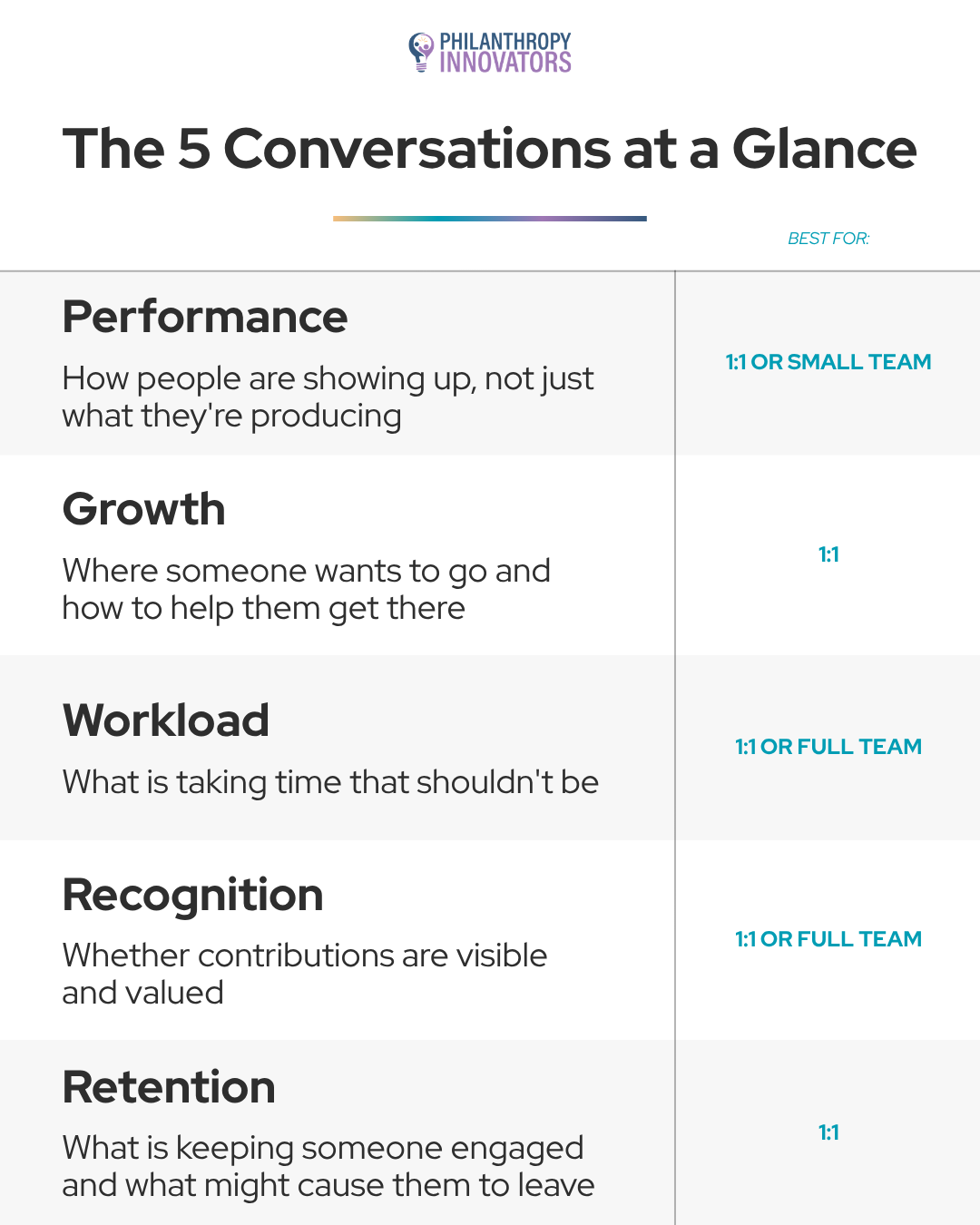
This article outlines five conversations that leaders should have each quarter, at a minimum. They are not a rigid framework, but topics that should show up regularly in how you lead your team, in whatever format fits your organization.
Conversation 1: Performance, Not Just What But How
Most performance conversations in nonprofits focus on outputs: dollars raised, tasks completed, goals met. These numbers matter, but they tell only part of the story.
Performance is also about how people show up. Are they building trust with donors and colleagues? Are they communicating clearly? Are they aligned with priorities, or quietly stuck?
Research from Harvard Business Review on building trust on teams reinforces what most of us have seen ourselves: trust is the foundation of performance. When people feel safe to name challenges, they are far more likely to address them.
We can build trust and have effective performance conversations by adopting a “feedforward” mindset. This practice comes from Marshall Goldsmith Stakeholder Centered Coaching, a methodology I use in my own leadership coaching. Rather than dwelling on what went wrong, team members focus on what can be strengthened going forward.
Strong accountability is built through conversation, not delivered as a verdict.
These discussions work best in one-on-ones, where individuals can speak candidly. They also have a place in team settings, where patterns around priorities and alignment can surface.
Questions to ask:
- "What's working really well for you right now?"
- "Where are you getting stuck, and what do you need to move through it?"
- "How are you building trust with donors and with your colleagues?"
Further Reading: For more on building engaged nonprofit teams, read
Building Engaged Nonprofit Teams

Conversation 2: Growth, Where Are You Going Next?
This is the conversation most leaders hesitate to have and I understand why. In a sector already stretched thin, asking someone where they want to be in five years can feel risky.
What if their goals outpace what you can offer?
But avoiding the conversation carries a greater cost.
When you ask about growth, you signal that you see your team members as more than their current role. You show that you are invested in where they are going, not just what they are producing today. That shift changes the relationship by building commitment and trust.
This conversation works best one-on-one, where people can be honest about what they want. They do not need to be formal or time-consuming. The goal is to make growth part of your regular dialogue, not something saved for annual reviews or exit conversations.
In a sector facing significant staffing shortages, the leaders who understand what their people want and actively help them get it will retain talent that others lose.
Questions to ask:
- "What do you want more of in your role right now?"
- "Where do you want to stretch in the coming months?"
- "What kind of experience or opportunity would move you forward professionally?"

Conversation 3: Workload, What Actually Matters
One of the principles I return to often in my work is this: only do what only you can do.
When I share this with leaders, it usually lands quickly. Most teams know their time is being pulled in too many directions.
The issue is usually about misalignment, rather than effort. Work creeps in that does not match the role, the individual’s strengths, or what the organization needs most right now. That gap comes at a cost, both in energy and in missed opportunity.
Here’s an example most of us can relate to. Bloomerang brings awareness to the issue that opportunity costs of fundraising events may not always be aligned with the enormous amount of effort that goes into them. Even worse, the hours spent preparing for an event could come at the cost of missed opportunities, such as key major gift conversations.
The workload conversation is where that math gets surfaced. In team settings, it can surface shared patterns that are pulling focus. In one-on-ones, it creates space for people to be honest about what is getting in the way. Either way, it allows leaders to reset priorities before burnout does it for them.
Questions to ask:
- "What's taking time right now that probably shouldn't be?"
- "What are we saying yes to that's pulling us away from our real strategy?"
- "What should we stop doing, or stop doing the way we're currently doing it?"

Conversation 4: Recognition, Making Contributions Visible
Recognition is one of the most under-leveraged tools in leadership, and one of the earliest signals of whether someone will stay engaged or begin to pull back.
The Fractional Chief Development Officer is intended to move organizations forward, not just maintain momentum. That forward movement can create discomfort, which may surface when fundraising priorities shift and accountability becomes more visible through regular reports and progress updates.
These moments can feel tense because fundraising work is relational and nonprofits tend to attract individuals who are mission driven and committed to the causes they serve. As a development professional, the job is to build deep trust with donors by translating the impact of their philanthropy to the mission of the organization. Any perceived threat to those relationships can feel threatening.
Discomfort is not a sign that something is wrong. It is often a sign that the organization is engaging in deep work and taking steps to move in the right direction. The role of a leader is not to eliminate discomfort. It is to contextualize it by reinforcing key messages.
Instead of pushing through any discomfort, use it as an opportunity to reinforce progress through praise. These situations provide an opportunity to acknowledge that change is difficult, and that it feels very different than maintaining the status quo. One of the most important habits to instill in the team is to celebrate wins early and often to mark the progress toward shared goals.

Conversation 5: Retention, A Shared Responsibility
With over 50% of U.S. workers actively looking for a new job, retention is no longer a background concern. It requires direct, ongoing conversation.
The strongest teams I work with don’t wait for exit interviews. They talk about this openly while people are still there.
This conversation belongs in a one-on-one setting. Questions about staying or leaving require honesty that rarely surfaces in a group. I encourage leaders to ask directly, even if it feels uncomfortable. The answers are often more practical than expected and give you a chance to respond before it is too late.
Retention starts with leadership, but it is shared across the team. These conversations create the shared accountability that holds a team together over the long term.
Questions to ask:
- "What's keeping you here? What's energizing about your work right now?"
- "What might cause you to start looking elsewhere?"
- "What do you need more of to stay fully engaged?"
Further Reading: For a deeper guide on structuring retention conversations, see:
The Power of Stay Interviews in Philanthropy

Why This Is a Fundraising Issue, Not Just a Management Issue
Strong teams are built through consistent, honest conversation. This is what sustains a culture of philanthropy.
If you are reading this thinking, "These are important, but my real job is philanthropy," I want to gently push back.
These conversations are your work, and tending to them on a regular basis will significantly enhance your ability to raise dollars in support of your mission.
Major gifts require deep listening. Most practitioners agree a strong gift officer spends at least two-thirds of a donor conversation listening. That capacity for attentive, trust-building dialogue does not start in donor meetings. It is shaped by the culture a leader creates internally. When your team operates with clarity, candor, and mutual respect, that quality of relationship shows up in how they engage donors.
The reverse is also true. Unclear expectations lead to weaker donor conversations. Burnout erodes the energy required for relationship building. High turnover disrupts connections that took years to establish. There is a direct link between how you lead your team and the effectiveness of your fundraising efforts.
A Simple Way to Start
You do not need to redesign your management approach or schedule a new series of meetings. You need one intentional conversation.
Look at the five topics above and ask yourself which of these feels most absent in how you are currently leading your team? Start there. Find a natural opening in an upcoming one-on-one, a quiet moment after a team meeting, or a check-in that usually stays surface-level. Ask a real question and listen to the whole answer.
Then do it again. With the same person, or with someone else. Let the rhythm build before you build a system around it. You don't need to get all five right immediately. Start with one conversation, but make it real and make it consistent.
You don’t build a culture of philanthropy in a planning session, but rather in the conversations you have every day with your team.
If you want better results, start with better conversations.
A shortened version of this article can be found on Forbes.com: 5 Conversations Nonprofit Leaders Should Have Every Quarter
Share this Story: